The Hobbit Trail, Part 3: Encounters with the Shadow
- Sep 2, 2025
- 5 min read
Updated: Sep 3, 2025
The elements of nature aren’t always enchanting, beautiful, and serene like the scene in Rivendell; nature is also mysterious and dangerous, as when Bilbo and company travel across Misty Mountains. And as embodied by the character of Beorn—a half-man, and half-beast. The travels along the mountain trail was becoming hazardous, for not only was it raining heavy, but rocks were flying around like a football which giant creatures from the distance were throwing for sport. So, the company was forced to seek refuge inside a cave. For entering a dark unknown cave was safer than getting hit by a rock in the slippery mountains and heavy rain.
In mythology, the theme of “entering the cave” symbolizes the stage where the “hero” enters the deepest, darkest part of themselves— into the depths of their mind.
Encounters inside a cave occur twice in The Hobbit; first, inside Misty Mountains with Gollum, and then at The Loney Mountain with the dragon Smaug. One must venture with caution when entering the inner depths of the mind, for there are many hidden dangers which must be approached and disarmed gently. The depths of the mind are symbolized by darkness, which leads one to think there's nothing present, but there's an entire energetic field of consciousness at the depths of that ocean. It’s in the dark night of the soul that challenges are encountered, which offer the opportunity to develop human character. Fictional characters like Bilbo are relatable because we too encounter similar scenarios.

Chapter 5, Riddles in the Dark, is a key chapter in Tolkien’s entire mythology, it's there when Bilbo finds the One Ring, the central theme of the entire legendarium. In earlier editions of The Hobbit, the ring didn’t carry much weight for the story. In fact, Gollum had willingly given the ring to Bilbo in the first edition of the book. But as Tolkien developed his mythology further, especially when writing The Lord of the Rings, the One Ring gained a stronger center of gravity. Tolkien eventually had to rewrite Chapter 5 for the second edition of The Hobbit in order to keep it consistent with the Lord of the Rings. Creativity develops and unfolds unexpectedly, which causes the reorientation of a project in creative fiction— and real-life. As when someone encounters Tolkien’s work for the first time—it changes everything.
Gollum represents a contrast to Bilbo—the shadow. In The Lord of the Rings, Gandalf’s contrast (shadow) is projected onto Saruman. Tolkien uses contrasting character types in order to demonstrate the wide range of human personality types. Gollum represents the extreme end of dark human traits: greed, addiction, malevolence.
Bilbo survives the encounter with Gollum, and the rest of the company manages to escape their encounter with the goblins—with a little help from Gandalf. Everyone finally escapes back out the cave of Misty Mountains. But they immediately run into more obstacles and challenges. They encounter the wolves— called Wargs—who begin to chase the dwarves and Bilbo. The company had to climb up the trees in order to find safety, for wolves can’t climb trees. So, the Wargs decided to burn the trees along with the dwarves. At this point, it seemed like the end, for there was nowhere to escape.
In this scene, the concept of Eucatastrophe is demonstrated, where a sudden joyous turn occurs in a situation that seems fatal. Eagles arrive unexpectedly and swoop the company away from danger. Eagles are very symbolic, they represent mighty beings that can see from a higher perspective, like wise teachers, or angels. However, the eagles don’t fly them all the way to their ultimate destination, for great powers will assist only when necessary and will not do all the work for us. For example, a parent will guide their children in early development and only intervenes when truly necessary. Or, in the music industry, when a major artist supports local artists by offering them a platform as an opening act, which gives the local artist a lift in exposure and propels their career forward. It’s interesting to note that acts of grace come by way of other people, often by those who see life from a higher perspective and are connected to higher values, and understand their role as leaders in their community--who serve as angels of their communities. In myth, Joseph Campbell calls this “supernatural aid.”
The first step in changing human behavior is to encounter oneself in the darkness of the inner cave—the depths of our mind. We the readers are both Bilbo and Gollum, and in order to transform our darker human characteristics, we must transmute and purify our vices in order to reveal the gems of virtue, knowledge, and wisdom which “the shadow” likes to keep hidden.
Bilbo’s challenges grow in scale and intensity throughout the story. First, he encounters trolls, then meets Gollum, and finally encounters the great dragon Smaug. Each phase prepares the hero for the next level of challenges. Human psychological development occurs in similar stages, which gradually increases in complexity and intensity. This epic journey of our lives is to be discovered page by page, and chapter by chapter.
As Bilbo's journey unfolds, he begins to establish himself as a worthy member of Thorin’s company. He proved himself in times of trial and is now seen as a skillful courageous hobbit, for the dwarves are impressed that he survived the trials at Misty Mountains. Trust and comradery is developed amongst the fellowship after overcoming these set of challenges. Character development isn’t just about physical strength and courage, but also consists of a emotional and psychological growth; as demonstrated when Bilbo had the chance to slay Gollum but chose to spare his life—which demonstrates compassion.
The genius of any author of fiction, is to create characters that are relatable, who demonstrate a path forward in human development. That’s how myth and fairytales are passed along the arc of human history.
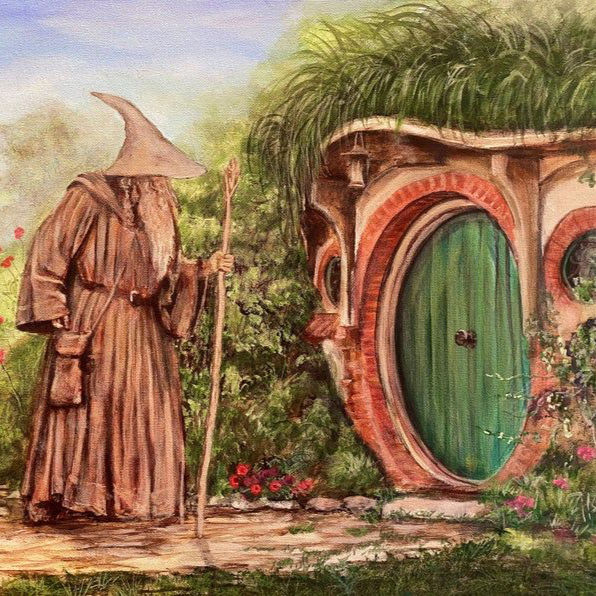
An example of the importance of good storytelling is demonstrated by Gandalf in Beorn’s house. Beorn is a half-man, half-beast, which means that diplomacy must be delivered in order to establish trust and form an alliance with the traveling group of dwarves. Gandalf doesn’t overpower Beorn or force the dwarves into his house, instead, he tells stories and gradually introduces the dwarves a pair at a time, until eventually all fourteen members of the company have skillfully “intruded” Beorn’s house. This scene mirrors the opening chapter "An Unexpected Party," for Gandalf performed the same strategy at Bilbo’s house when introducing the dwarves at the Shire. Through skillful diplomatic talks and storytelling, people can form fellowships and alliances in a polarized society.
In chapter 7, the company begins preparing for their greatest challenge yet, entering the wilderness of Mirkwood where giant spiders dwell. The greatest piece of advice Beorn offers the company is to not stray from the path. There’s a path that cuts right through the forest, which if followed without distractions, will make the journey less difficult than it ought to be. But of course, things don’t always go as planned.
In conclusion, we followed the hobbit’s trail up to chapter 7, familiarizing ourselves with some themes and exploring the psychological significance of some steps of the journey. The hardest step in any new quest is taking that first step. It is by way of myths and fairy stories that introduce us to new adventures, which inspire and call us to begin exploring the various trails available for exploration. The Hobbit, although a children’s story, serves as one of the many tales that offer a way into these magical worlds of magic and enchantment--which eventually become manifest into a new reality.


Comments