The Hobbit Trail, Part 1: Departure
- Aug 27, 2025
- 8 min read
Updated: Sep 1, 2025
Certain stories become classical and get told generation after generation. Stories, in whatever shape or form, serve a vital function within society: they inspire, enchant, guide, and form communities. Many people in society feel lost and begin to search for clues on how to properly navigate their lives. Eventually, they’ll come across stories which open the doors of possibility, and connect them to deeper roots. One such story which narrates the quest for adventure is the timeless tale of J.R.R. Tolkien’s The Hobbit. A simple children’s story that serves more than just mere entertainment, for its underlaid with a rare Elvish craft that connects the reader to an alternate dimension that Tolkien calls Faerie. This hobbit’s tale illustrates in symbolic narrative form the quest towards the discovery of a psychological treasure—guarded by a dragon—and maps a route towards the great human endeavor of discovering the Elvish craft of magic and enchantment; which is hidden and dormant at the depths of consciousness within all human beings.
In this essay series, I’ll present an outline of the major themes found within J.R.R Tolkien’s The Hobbit. I’ll point out and describe events and symbols which illustrate a deeper profound meaning. We’ll cover concepts and ideas that’ll connect the reader to an underlying stream within this genre of fantasy, the story within the story, the land of Faerie. The field of academic study dedicated to Tolkien’s hidden worlds of Middle-earth is classically called Tolkien Studies; this field will be the primary source material for our exploratory quest, and from this point of departure is where our long-awaited journey begins.

Legacy and Tradition
Genres of literature typically revolve around an important historical figure’s body of work or legacy. To illustrate this concept, let’s compare it to the orbits of planets and the solar system. The Moon revolves the Earth which revolves around the Sun, which in turn revolves the around the center of our Milky Way galaxy. Beyond the galaxy, science cannot verify anything beyond. Without going too deep into astronomy, we can notice the pattern of things orbiting other objects or forces, therefore, we can hypothesize that there must be a central force in which the Milky Way orbits, until one gets to a universal force in which all galaxies of the universe orbit—this puts us in the realm of speculation, but it’s very reasonable to assume a center of gravity for all the galaxies.
In the same manner, genres of literature orbit previous genres. Authors don’t create bodies of work ex nihilo (from nothing). There’s always a central body of literature in which an author’s work revolves around. Those who study various myths--like Joseph Campbell-- are called mythologist; from which their body of work is centered aound. Tolkien too study various myths and fairy stories, but he clearly states that he derived his concepts from the place where all stories arise from, directly from the realm of Faerie. Classic stories can be traced back in history, and that’s how lineages and traditions are established and continued. Tolkien not only followed the tradition of fairy stories, he re-invented the genre. The Lord of the Rings was the body of work that changed the course of fairy stories, and The Hobbit was the prequel. Stories too revolve around a magic star--a sun--which Tolkien encountered directly. In every century, some figures arise with tales that become the myths of their era, many scholars believe Tolkien’s myth to be the “myth for our time.” In this essay, our study of fairy tale themes will orbit J.R.R. Tolkien’s The Hobbit. We’ll orbit events and symbols found in the plot. Tolkien’s mythology has generated interest amongst academics, scholars, independent artist and writers, which eventually has led to a formal field of study: Tolkien Studies. Our study of the themes found in The Hobbit will primarily reference this field which orbits around Tolkien's legacy.

One of the great functions of an established tradition is that current generations don’t need to figure things out from ex nihilo (from zero or a blank page). There are many writers in history who left behind their master works from which anyone can borrow and adapt to their current lifestyle. There’s no need to reinvent the wheel. The purpose of tradition is for current generations to come along and continue the work which previous generations began--like following a trail. What’s great about the field of Tolkien Studies is that there is a vast library of ideas, concepts, proposals, and commentaries from which our current generation may adapt and put to practical use. Tolkien is considered a true genius, and by studying him, we may figure out a path that leads to that field where those great ideas emerged from—the land of Faerie.
Tolkien provides two maps in The Hobbit: Thror’s Map and Wilderland; both of which cover the terrain traveled within the story. Fairy tale maps aren’t simple illustrations for personal amusement only, they contain deeply encoded meaning which is brought forth into conscious awareness through an initiated individual—a wizard, magician, or esoteric teacher like Elrond at Rivendell. Those who understand the esoteric language can read the symbolism which reveals aspects of “the way.” Within any great tale—like The Hobbit or Lord of the Rings—the author’s aim is to reveal these insights in a style that an audience may find engaging and meaningful, and which leads them towards better decision-making; decisions that are more productive in our life’s quest. The natural inclination of any reader upon discovering various hints of the world beyond a tale, is to find a school designed to further explore, explain, and reveal those mystery worlds—often called a Mystery School, Wisdom School or Esoteric Academy. A spiritual map—either in fiction, philosophy, or psychology—shows the Seeker a general direction in which to travel on their next step or stage of the journey. Thor’s Map and the map of Wilderland will be our guiding roadmaps which will illuminate the path ahead. The role of an esoteric teacher, guide, or pastor, is to reveal the symbols contained within these roadmaps--similar to the role Elrond and Gandalf play in the tale. The symbolism of mountains, dragons, forests, and rivers, begin to be revealed as the path is explored with a reliable guide, mentor, teacher, or genre of literature.

The Shire
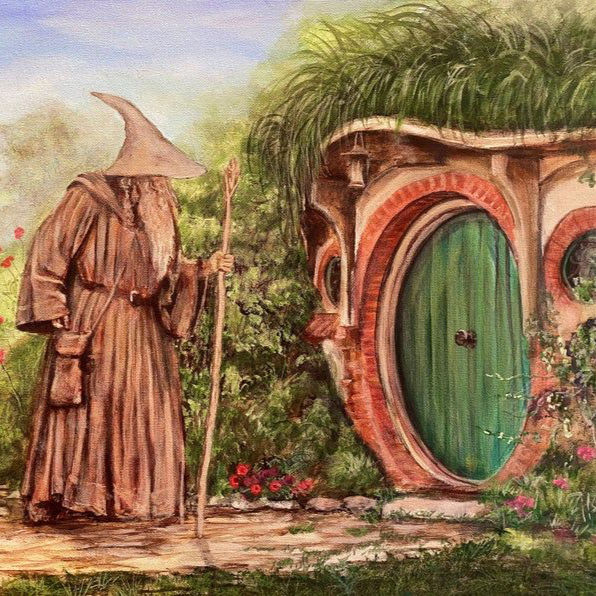
The world of Middle-earth is wide and deep. There are various regions that offer riddles and challenges which upon successfully overcoming grant the traveler access to their next phase or stage of the Quest. Every journey has a beginning, middle, and end, and our point of departure begins in a place known as The Shire, in the small town of Hobbiton. The Shire is comfortable and quiet, not much happens around those towns. Stories of dragons, elves, and wizards are mentioned around town, but they are simply far-off fairy-tale ideas that never actually happen in simple everyday affairs. The Shire represents a safe ordered life where there are no adventures or quests, just the habits and patterns of day-to-day activities, it’s the comfort zone. For example, we often get too comfortable in a job, which we simply do just to pay the bills. Then maybe on the weekend, if our job even allows weekends off, one may get to experience a short getaway. The comfort and habitual patterns of daily routines are what Tolkien associates to the Shire, which isn’t just a fairy tale concept but an actual experience people dwell in the common world--what Joseph Campbell called the Ordinary World. A brief reflection on this concept leads one to realize that the majority of Americans dwell in the Shire—the Ordinary World—and haven’t experienced much beyond its borders.
A narrative theme which unfolds in the first chapter of The Hobbit is the concept of intrusion. Initially, Gandalf made a simple visit to Bilbo’s home in order to compel him to embark on a quest, but Bilbo wasn’t convinced or interested. Gandalf, therefore, departs Bilbo’s home for a brief moment, and marks a symbol on the door. This magical act invites the company of thirteen dwarf warriors who enter Bilbo’s home one pair at a time, thus creating a gradual intrusion. This scene symbolizes the intrusive thoughts which arise in the imagination, and gradually build a strong grip, which captures and demands our attention. The function these psychological intrusions provide is that they lead an individual, group, or community, to the next step of the process—the beginning of the Quest out of the Shire.
Bilbo Baggins, although initially denying the call for adventure, still listens to the dwarf company, led by Thorin, talk about plans of slaying dragons and recapturing the great treasure. Similar to most people who lean into interesting stories friends tell, in hopes that one day they too may embark on an adventure. Bilbo entertains the idea of going on a quest but has not yet made the commitment to step outside the doors of his home and cross over to the next step of embarking on that quest. This impulse of adventure is dormant in all beings—humans and hobbits—and eventually, gains enough strength to propel a person to cross over the first bridge and take the first step. The point of separation between the Shire and the unknown lands is symbolized by crossing over a river. This is the point of departure of any quest, where all the great tales begin. Bilbo Baggins living comfortably in the Shire without adventures is the perfect scene to begin an intrusion, or at least introduce a fairy tale, one that takes us far beyond the limits of the imagination.
Awakening Effect of Music
Music has always played a vital role in society. Its function isn’t just “for entertainment purposes only,” but serves as healing medicine for the mind, body, and soul; for it awakens a deeper psychological and spiritual calling. Music’s effect as an awakening force is demonstrated in the opening chapter of The Hobbit, “An Unexpected Party.” After the dwarfs’ gradual intrusion into Bilbo’s home—physically and psychologically—they begin to sing a song deep in tone and slow in rhythm, which feels mystical. The song speaks of mountains, caves, a dragon, and gold. And when the dwarfs begin singing in harmony something unexpected happens to Bilbo: a sense of curiosity and the impulse of adventure awakens within him. The Tookish trait arises from within him, the character trait which Bilbo Baggins got from his mother Belladonna Took.

Music evokes a wider calling beyond the limits and comforts of our imagination. Every genre of music causes this effect. It’s as if the whispers of the underlying message of music enters the mind like a gentle breeze through an open window, offering a breath of fresh air to the deeper dimensions of the imagination—to the soul. The effects of the dwarves’ singing offer three vital things: 1) it creates an atmosphere that contrasts the initial comic intrusion of when the dwarfs entered the home, into something serious and somber, 2) it establishes the purpose of the quest in song form, and 3) it awakens the Tookish adventurer’s impulse in Bilbo.
Music plays a deep and profound effect in any scene or space—whether fictional or reality. Music uplifts the atmosphere and raises the mood of a room or environment. We can detect this effect when comparing a room that’s quiet—like a library—to a room where background music is gently playing, like a café. Music also offers group identity; as when a group of strangers in a concert hall sing together as one harmonic voice, as in the case of the chorus of a song--unity of mind and spirit are established. Music also evokes a sense of nostalgia which takes people back to their “better days.” From a mythic perspective, this nostalgia is a call to come back and explore that adventurous impulse, that awakens what many people call the soul. Eventually, the impulse for a journey builds up with such propensity, that it propels the individual to embark on a path or quest, which leads to the first major step of the journey: crossing the first threshold.
In the next part of this essay series, I’ll cover the initiation aspects of the quest.


Comments